
Artificial Intelligence Is Changing Injection Molding: What’s Next for Contract Manufacturing?
Artificial intelligence (AI) has moved well beyond the technology headlines. What once seemed like a futuristic concept is increasingly finding practical applications throughout manufacturing, including plastic injection molding. From analyzing production data and identifying potential quality issues to improving cycle times and anticipating equipment maintenance, AI is creating new opportunities for manufacturers to improve efficiency, consistency, and customer service.
In June 2023, Total Plastic Solutions (TPS) published an article titled Is AI Changing Contract Manufacturing? At the time, we explored how AI could potentially transform manufacturing through predictive maintenance, automated quality control, supply chain optimization, and intelligent production systems.
Three years later, those predictions are becoming reality. So, what has changed, and what does it mean for OEMs looking for an injection molding contract manufacturing partner?
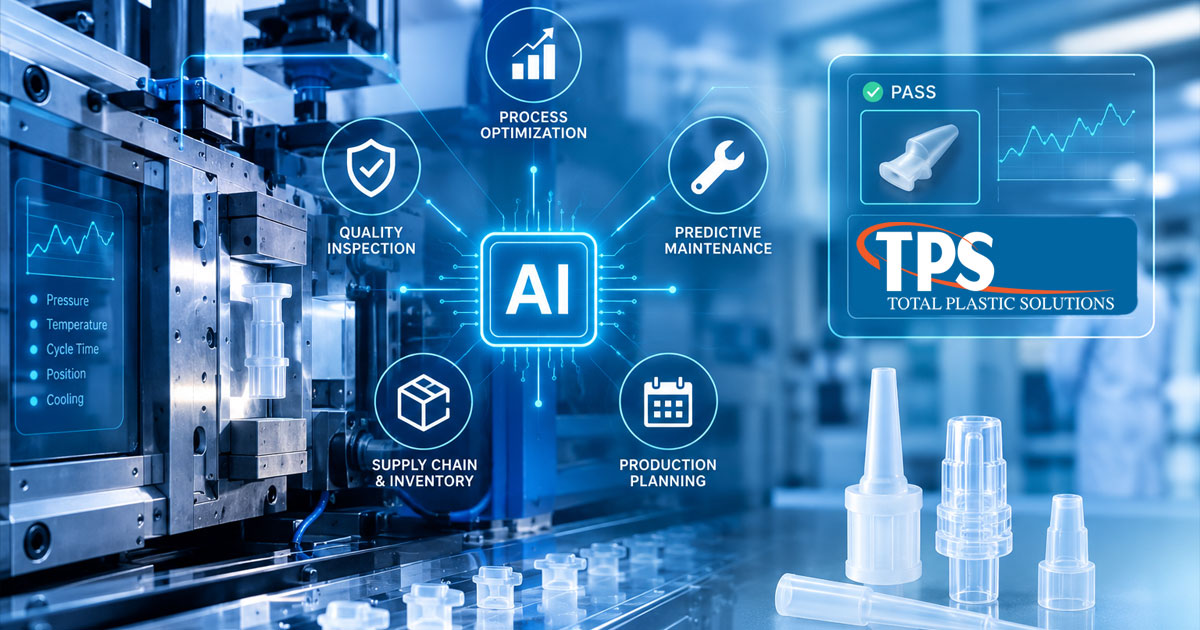
1. Smarter Injection Molding Through Real-Time Process Data
One of the most promising applications of AI in injection molding is its ability to analyze production data and identify relationships that might otherwise go unnoticed.
Modern injection molding machines and connected sensors can collect significant amounts of information during every production cycle. This includes injection pressure, melt temperature, screw position, cycle time, cooling performance, and other critical process variables.
AI-powered analytics can evaluate this information to identify patterns, recognize process deviations, and recommend adjustments to improve production performance.
For example, AI-assisted process monitoring may help identify subtle changes in molding conditions before they result in dimensional inconsistencies, cosmetic defects, or increased scrap rates. Advanced systems can also analyze cavity pressure and temperature information to better understand what is happening inside the mold during production.
The potential benefit is greater process consistency, less material waste, and improved production efficiency.
Rather than relying exclusively on historical troubleshooting and operator observations, manufacturers can increasingly use real-time information to make better-informed decisions.
2. AI Is Making Quality Control More Predictive
Quality control is another area where AI is beginning to make a meaningful difference.
Traditional inspection methods often rely on sampling, operator visual inspection, and established measurement procedures. These remain important tools, but AI-powered vision systems introduce additional opportunities for automated inspection.
Advanced camera systems can inspect molded components for characteristics such as flash, short shots, discoloration, surface imperfections, and other visual defects. Machine learning can help distinguish acceptable variations from conditions that require further investigation.
Some systems can also associate defects with individual mold cavities, helping manufacturers identify tooling or process problems more quickly.
This is particularly interesting for high-volume, multi-cavity injection molding applications where identifying the source of a recurring defect can be challenging.
For medical device manufacturers, the implications are especially important. Consistent product quality, documented inspection procedures, traceability, and controlled manufacturing processes remain essential. AI may provide another layer of information to support these objectives, but it does not replace established quality systems, validated processes, or human oversight.
3. Predictive Maintenance: Addressing Problems Before Production Stops
Unplanned equipment downtime can be expensive for both contract manufacturers and their customers.
AI offers an opportunity to move beyond traditional preventive maintenance schedules by analyzing machine performance, operating history, cycle information, and equipment condition.
For injection molding operations, this could include identifying unusual trends associated with hydraulic systems, screw and barrel performance, mold cooling, ejector mechanisms, and other critical equipment.
Similar approaches can be applied to mold maintenance. Changes in cycle time, process performance, or recurring quality issues may provide early indications that a mold needs attention.
The objective is straightforward: identify potential problems earlier, schedule maintenance more effectively, and reduce unexpected interruptions to production.
For OEM customers, improved equipment reliability can translate into more dependable delivery schedules and a more resilient supply chain.
4. Better Production Planning and Supply Chain Management
AI’s impact extends beyond the injection molding machine itself.
Contract manufacturers must coordinate raw materials, production capacity, tooling availability, labor, inventory, customer forecasts, and shipping requirements. These variables are interconnected, and a change in one area can affect the entire production schedule.
AI-assisted planning tools can analyze historical demand, current orders, inventory levels, and production capacity to help manufacturers make better scheduling and purchasing decisions.
Potential applications include:
- Demand forecasting: Identifying purchasing trends and anticipating future customer requirements.
- Inventory management: Improving raw material purchasing decisions and reducing unnecessary inventory.
- Production scheduling: Evaluating machine availability, tooling requirements, and order priorities.
- Delivery performance: Identifying potential scheduling conflicts and supply chain disruptions before they affect customer commitments.
For contract manufacturers, these capabilities could help improve operational efficiency while providing customers with better visibility and more dependable service.
5. The Human Element Still Matters
With all the excitement surrounding AI, there is an important distinction worth making: technology does not automatically create manufacturing expertise.
Injection molding remains a complex manufacturing process involving material characteristics, mold design, machine capabilities, processing parameters, cooling dynamics, and part geometry.
AI can help analyze information and identify opportunities, but experienced engineers and technicians are still essential to understanding the results and determining the appropriate response.
Scientific molding, process development, mold qualification, validation, and disciplined quality procedures cannot simply be replaced by an algorithm.
There are also practical considerations surrounding data quality, machine connectivity, cybersecurity, and the cost of implementing new technologies. Not every AI application makes economic sense for every manufacturing operation.
The most successful manufacturers will be those that understand where technology adds measurable value and implement it without compromising established manufacturing and quality practices.
What Does This Mean for OEMs Selecting an Injection Molding Contract Manufacturer?
As AI becomes more integrated into manufacturing, OEMs should consider how their contract manufacturing partners evaluate and adopt emerging technologies.
However, technology should be only one part of the supplier selection process.
An experienced injection molding partner should also demonstrate:
- Strong engineering and design-for-manufacturability support.
- Scientific molding and disciplined process development.
- Effective tooling maintenance and process optimization.
- Robust quality systems and manufacturing documentation.
- The ability to manage complex projects from initial development through production.
- A commitment to communication, customer satisfaction, and continuous improvement.
For medical device OEMs, additional considerations include experience with ISO 13485 quality management systems, controlled manufacturing environments, cleanroom operations, and the documentation and process controls necessary to support regulated products.
Ultimately, customers need more than a supplier with the latest technology. They need a manufacturing partner capable of consistently delivering quality products, solving problems, and responding to changing business requirements.
Looking Ahead: AI and the Future of Injection Molding
The next phase of AI in contract manufacturing will likely involve greater integration between injection molding machines, quality inspection systems, manufacturing execution software, and enterprise resource planning platforms.
As these systems become more connected, manufacturers will have opportunities to make decisions based on a more complete picture of their operations.
The potential is significant: improved process consistency, reduced scrap, better equipment utilization, more efficient production planning, and stronger supply chain performance.
At Total Plastic Solutions, we believe that technology should serve a practical purpose: helping us meet customer expectations and continually improve the manufacturing solutions we provide.
Our focus remains on combining injection molding expertise, engineering support, disciplined manufacturing practices, and ISO 13485 cleanroom contract manufacturing capabilities to support OEM customers with demanding applications.
AI will undoubtedly influence the future of injection molding. But the fundamentals of successful contract manufacturing remain unchanged: quality, consistency, attention to detail, technical expertise, and a commitment to the customer.
Ready to Start Your Next Medical Molding Project?
Are you looking for an injection molding contract manufacturing partner for your next project? Contact Total Plastic Solutions to discuss how our engineering, injection molding, and cleanroom manufacturing capabilities can support your requirements.
Or reach out through our contact page to start the conversation.


